
Icarus & Daedalus: The Flight Too Close to the Sun
The Imprisonment of Daedalus
Daedalus was the greatest inventor, architect, and craftsman of Greek mythology. For example, he built the Labyrinth for King Minos of Crete to contain the Minotaur. However, after helping Theseus escape the Labyrinth (by giving Ariadne the thread), Daedalus fell out of favor. Consequently, King Minos imprisoned Daedalus and his young son Icarus in a high tower on the island of Crete, determined to keep the secrets of the Labyrinth from spreading.
The Invention of Wings
Daedalus, being too clever to be contained, began observing the birds flying over the tower. He then started collecting feathers of all sizes and securing them together with wax and thread. In this way, he crafted two pairs of wings – one for himself, one for Icarus. Once the wings were ready, he taught his son how to fly. Specifically, he warned Icarus not to fly too low (or the sea’s dampness would weigh down the feathers) and not to fly too high (or the sun’s heat would melt the wax). Moreover, he instructed Icarus to follow him closely and to avoid both extremes.
The Flight and the Fall
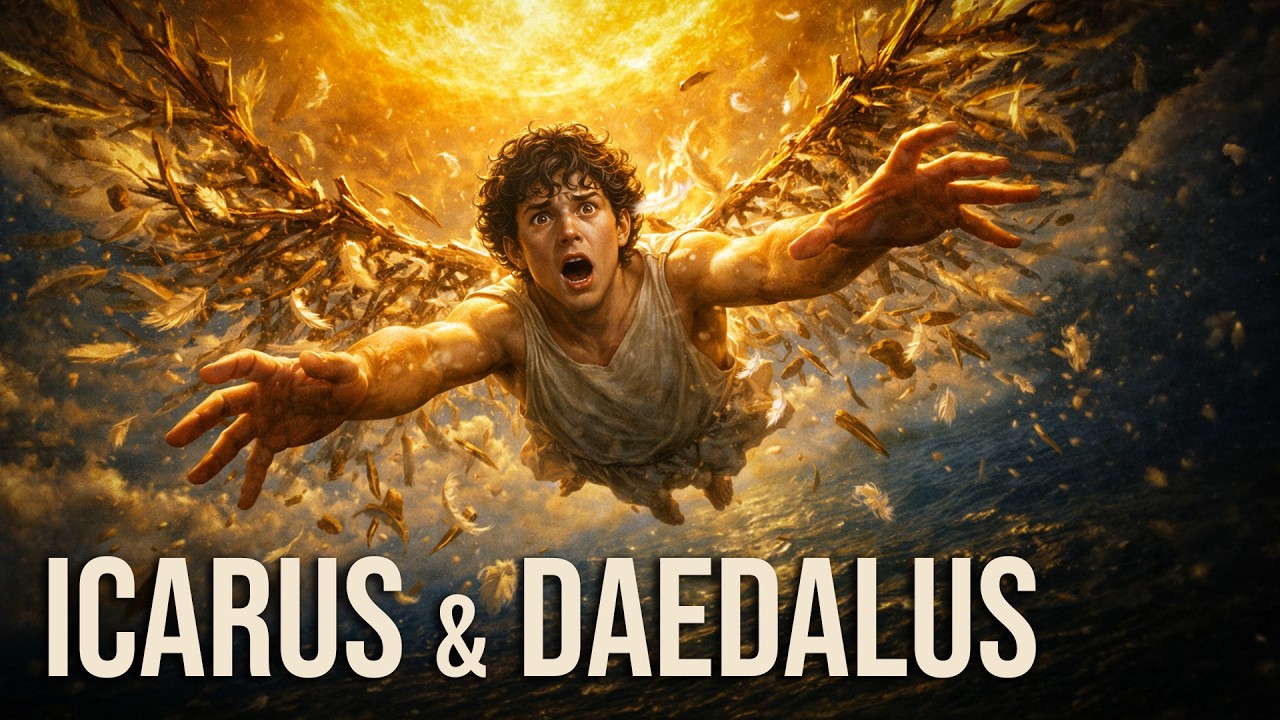
Father and son leaped from the tower and flew over the Aegean Sea. Shepherds and sailors below watched in awe, thinking they were gods. At first, Icarus obeyed his father’s warnings. Nevertheless, the thrill of flight overwhelmed him. He flew higher and higher, toward the sun, intoxicated by the freedom. As a result, the wax on his wings began to soften, then melt. Feathers fell away one by one. Icarus flapped his bare arms, but there was nothing left to hold him. He plunged into the sea below and drowned. The water where he fell was later named the Icarian Sea.
Daedalus, helpless, could only watch his son’s demise. He then flew on to Sicily, where he built a temple to Apollo and hung his wings as an offering. In fact, he never flew again.
Themes: Hubris, Invention, and the Middle Path
The myth of Icarus is the archetypal warning against hubris – excessive pride or overconfidence that leads to destruction. Additionally, it celebrates human ingenuity (Daedalus’s wings) while cautioning that every invention carries risk. The “middle path” – neither too high nor too low – is a recurring theme in Greek thought (the Golden Mean). Icarus ignored this wisdom and paid the ultimate price.
Modern interpretations vary. For instance, some see the myth as a critique of reckless ambition, while others celebrate the daring spirit that pushes boundaries. Artists like Bruegel (Landscape with the Fall of Icarus) and poets like Auden (“Musée des Beaux Arts”) have used the myth to explore human indifference to suffering and the quiet tragedy of ordinary life continuing after disaster.
Daedalus After Icarus
Daedalus reached Sicily, where he was welcomed by King Cocalus. He continued his inventive work, creating steam baths, honeycomb structures, and even a mechanical cow. Meanwhile, King Minos pursued him across the Mediterranean but was eventually killed by the daughters of Cocalus (or by boiling water, depending on the version). Therefore, Daedalus lived out his years in Sicily, forever haunted by the loss of his son.
Frequently Asked Questions about Icarus and Daedalus
Feathers (of various birds) held together with beeswax and linen thread.
King Minos ordered him to build it to imprison the Minotaur – a half-man, half-bull monster born from Minos’s wife Pasiphaë.
Its etymology is uncertain, but the myth has made the name synonymous with reckless ambition and failure due to overconfidence.
Yes, there is a part of the Aegean Sea called the Icarian Sea, near the island of Icaria, named after the myth.
Watch it for free on YouTube at Antiquity Illustrated. Subscribe for new myths every week.