
Theseus: Why He Was Not the Hero You Think
The Early Life of Theseus
Theseus was the son of Aegeus (king of Athens) and Aethra (a Troezenian princess). Before his birth, Aegeus placed his sword and sandals under a great rock, telling Aethra that when their son could lift the rock, he should bring the tokens to Athens. Theseus grew up in Troezen and, as a young man, easily lifted the rock. Instead of taking the safe sea route, he chose the dangerous land journey to Athens, clearing the road of six infamous bandits (including Procrustes, Sciron, and Sinis).
The Minotaur and the Labyrinth
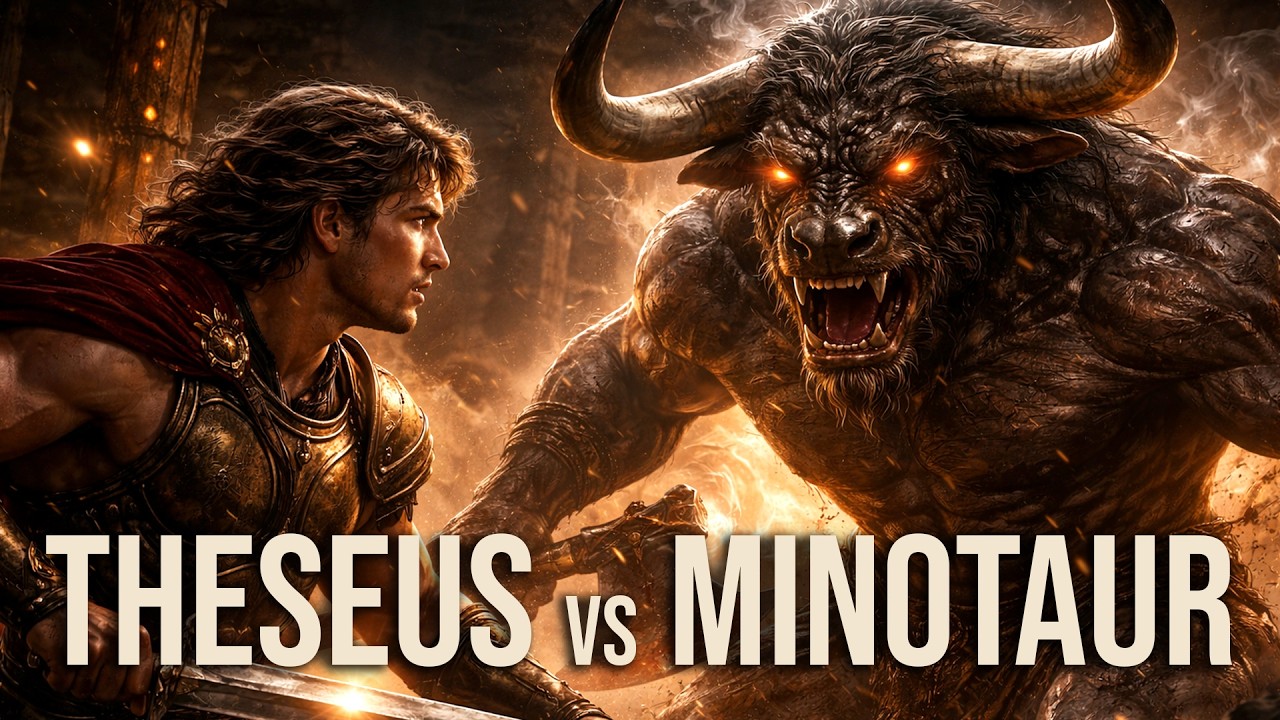
The most famous episode of Theseus’s myth is his mission to Crete. King Minos of Crete demanded that Athens send seven young men and seven young women every nine years as tribute to feed the Minotaur – a monstrous creature with the body of a man and the head of a bull, born from Pasiphaë and a white bull. The Minotaur lived in the Labyrinth, an inescapable maze designed by Daedalus.
Theseus volunteered to go as one of the tributes, vowing to kill the Minotaur. When he arrived in Crete, Princess Ariadne, daughter of Minos, fell in love with him. She gave him a ball of thread (the “clew”) so he could find his way back out of the Labyrinth. Theseus killed the Minotaur with his bare hands (or a sword), followed the thread back, and fled Crete with Ariadne.
The Abandonment of Ariadne
On the way back to Athens, Theseus stopped on the island of Naxos. There, for reasons that vary by version, he abandoned Ariadne while she slept. Some say he was compelled by the god Dionysus, who wanted Ariadne as his wife. Others say Theseus simply grew tired of her. Either way, Ariadne woke alone and heartbroken. This act stains Theseus’s reputation as a faithful lover.
The Sorrowful Return: The Black Sail
Before leaving for Crete, Theseus had promised his father Aegeus that if he survived, his ship would return with white sails. If he died, the crew would hoist black sails. In his grief over Ariadne (or in his haste), Theseus forgot to change the sails. When Aegeus saw the black sails approaching Athens, he threw himself from the Acropolis into the sea – which was thereafter called the Aegean Sea. Theseus thus unintentionally killed his own father.
The Later Crimes: Helen and Pirithous
After becoming king of Athens, Theseus’s moral decline continued. He and his friend Pirithous (king of the Lapiths) made a pact to marry daughters of Zeus. Pirithous wanted Persephone, queen of the Underworld. Theseus wanted Helen (later of Troy), who was only a child (around 12 years old). Theseus abducted Helen and left her with his mother in Aphidna, intending to marry her later. He then accompanied Pirithous to the Underworld to kidnap Persephone. Both were trapped: Pirithous was killed or eternally tormented, while Theseus was rescued by Heracles but had to remain in the Underworld for a time. Meanwhile, Helen’s brothers (Castor and Pollux) invaded Athens, rescued Helen, and took Theseus’s mother hostage.
Death and Legacy
When Theseus finally returned to Athens, he found that his throne had been usurped. He fled to the island of Scyros, where King Lycomedes, pretending to be friendly, pushed him off a cliff to his death. Centuries later, the Athenians recovered his bones and honored him as a hero – but the historical and mythological evidence reveals a deeply flawed man. Theseus was a rapist, an abandoner, a reckless adventurer, and an incompetent king.
Why the Myth Matters Today
Theseus’s story forces us to question the very definition of a “hero”. He accomplished great feats (unifying Attica, defeating the Minotaur, clearing the roads of bandits) but also committed unforgivable acts. Modern retellings often emphasize his ambiguities, making him a cautionary figure about power, pride, and the cost of glory.
Frequently Asked Questions about Theseus
Most versions say he used a sword given by Ariadne. Some vase paintings depict him using a club or his fists. The core is that he defeated the monster with cleverness (the thread) and strength.
No single answer. In most myths, he left her on Naxos either because he was ordered by Dionysus (who took her as his wife) or because he simply fell out of love and sailed away while she slept.
Theseus forgot to hoist the white sail indicating his survival. His father Aegeus saw the black sail and leaped to his death, thinking his son was dead.
Yes, according to most sources. He abducted the young Helen (future Helen of Troy) when she was a child, intending to marry her. This act was condemned even by ancient standards.
Watch it for free on YouTube at Antiquity Illustrated. Subscribe for new myths every week.