
Medusa: Monster or Victim?
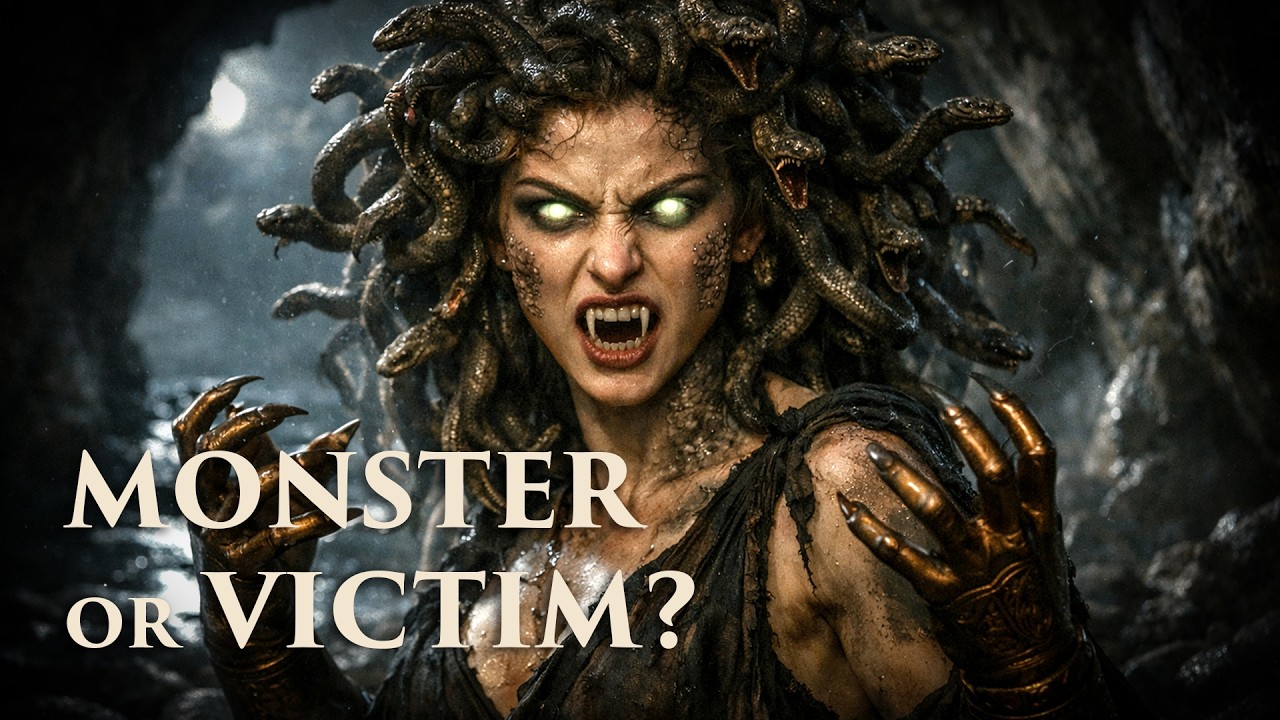
The Double Face of Medusa
Medusa is one of the most recognizable figures in Greek mythology. With snakes for hair and a gaze that turns men to stone, she is often portrayed as a terrifying monster. But is that the whole truth? Recent interpretations and ancient sources suggest a more tragic narrative: Medusa as a victim of divine violence and male power.
The Original Myth: From Beauty to Beast
According to the Roman poet Ovid in his Metamorphoses, Medusa was once a beautiful maiden, a priestess in the temple of Athena. She caught the eye of Poseidon, the god of the sea, who raped her inside the sacred temple. Enraged by the desecration — not at Poseidon, but at Medusa — Athena transformed the girl into a Gorgon: a creature with serpents for hair and a petrifying gaze. Any man who looked upon her would turn to stone.
In earlier Greek versions (Hesiod’s Theogony), Medusa was born a monster, one of three Gorgon sisters. But even then, she was the only mortal one — and she was killed by the hero Perseus, who used her severed head as a weapon.
Perseus and the Hero’s Quest
The most famous episode of Medusa’s story is her death. King Polydectes sent the young hero Perseus on a seemingly impossible task: to bring back the head of Medusa. With the help of Athena (who gave him a polished shield) and Hermes (who gave him a sword), Perseus approached Medusa while looking only at her reflection. He beheaded her in her sleep. From her neck sprang the winged horse Pegasus and the giant Chrysaor, children of her union with Poseidon.
Perseus then used the severed head to petrify his enemies and finally gave it to Athena, who placed it on her aegis as a protective symbol.
Symbolism and Modern Reinterpretations
In recent decades, Medusa has become a feminist icon. Her image — the woman with snakes, the “dangerous” female gaze — has been reinterpreted as a symbol of female rage and resistance against patriarchal violence. The very ability to turn men to stone becomes a metaphor for the power of silenced victims to freeze their abusers with the truth.
Artists like Luciano Garbati have subverted the myth: his statue “Medusa with the Head of Perseus” (2008) shows Medusa holding the hero’s head, turning the tables on the classic narrative.
Frequently Asked Questions about Medusa
No, Medusa was a Gorgon, a monstrous creature. She was not a goddess but a mortal (the only mortal among the three Gorgon sisters).
In Ovid’s version, Athena punished Medusa because the act happened inside her temple, defiling it. The goddess’s wrath fell on the victim rather than the god, reflecting ancient patriarchal norms.
It symbolizes protection (apotropaic power), female rage, survivor’s strength, and the danger of the feminine gaze.
The hero Perseus beheaded Medusa while she slept, using a mirrored shield to avoid her gaze.
You can watch it for free on YouTube at Antiquity Illustrated. Don’t forget to subscribe for more Greek myths every week.