
Pandora’s Box: Curiosity and the First Curse
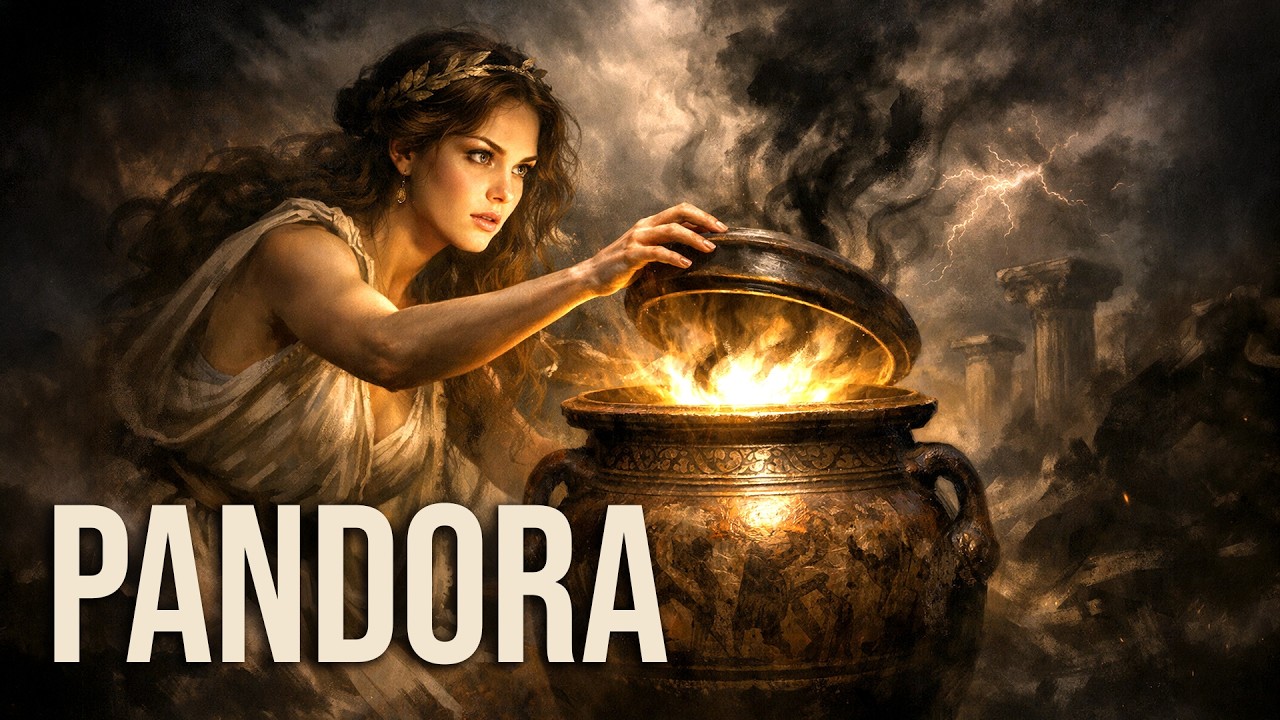
The Creation of the First Woman
After Prometheus stole fire and gave it to humanity, Zeus was furious. He decided to punish both the Titan and all mortals. He ordered Hephaestus (the god of craftsmanship) to create a woman from earth and water. Each god gave her a gift: Aphrodite gave her beauty, Athena gave her clothing and skill, Hermes gave her persuasion and a deceitful nature, and Zeus himself gave her a jar (pithos) containing all the evils and sorrows of the world. They named her Pandora – “all-gifted” or “all-giving”.
The Jar (Not a Box)
The famous “Pandora’s box” is a translation error from the 16th century. The Dutch scholar Erasmus mistranslated the Greek word pithos (a large storage jar) as pyxis (a small box). The original story by Hesiod (c. 700 BCE) clearly describes a sealed jar. Pandora was sent to Epimetheus (Prometheus’s brother), who ignored his brother’s warning and accepted her as his wife.
Curiosity Unleashes Suffering
Pandora had been told never to open the jar. But her curiosity (a gift from Hermes) overwhelmed her. One day, she lifted the lid. Out flew all the evils that plague humanity: sickness, toil, envy, greed, old age, death, and countless others. Terrified, she slammed the lid shut, but only one thing remained inside: Elpis, the spirit of hope.
Thus, according to Greek myth, humanity was cursed with all the hardships of life, but hope was left as a consolation. Whether hope is a blessing or a further curse (delaying despair) is a question the myth leaves open.
Interpretations and Symbolism
Pandora is often seen as a Greek Eve – a woman whose curiosity brings ruin. But many modern readings challenge this misogynistic interpretation. The jar was given to her by Zeus as a trap; her curiosity was not a flaw but a human quality. The myth also explores theodicy: why does a just god (Zeus) allow suffering? Hesiod’s answer is that suffering is a punishment for Prometheus’s theft, but also a permanent feature of mortal existence.
The phrase “opening Pandora’s box” has become a metaphor for any action that seems harmless but unleashes uncontrollable complications.
Pandora in Art and Literature
Pandora has inspired countless works: plays (Sophocles, although lost), paintings (Rossetti, Waterhouse), operas, and modern retellings. In the Percy Jackson series, Pandora’s jar appears as a magical container. She remains a potent symbol of feminine curiosity, divine punishment, and the ambiguous gift of hope.
Frequently Asked Questions about Pandora
To punish humanity after Prometheus stole fire. Pandora was a “beautiful evil” – a trap for Epimetheus and all mortals.
All the evils of the world: sickness, death, labor, envy, greed, and many others. Only hope remained inside.
It’s ambiguous. Hope can be a comfort, but it can also be a deceitful illusion that prevents action. Hesiod’s text does not clearly say.
Epimetheus, brother of Prometheus. He ignored his brother’s warning not to accept any gift from Zeus.
Watch it for free on YouTube at Antiquity Illustrated. Subscribe for new myths every week.